RESOURCES AND INFORMATION
AKC BREED STANDARD DESCRIPTION
Toy Group
General Appearance
A graceful, alert, swift-moving, compact little dog with a saucy expression and with terrier-like qualities of temperament.
Size, Proportion, Substance
Weight—A well-balanced little dog not to exceed 6 pounds. Proportion—The body is off-square; hence, slightly longer when measured from point of shoulder to point of buttocks than height at the withers. Somewhat shorter bodies are preferred in males. Disqualification—Any dog over 6 pounds in weight.
Head
A well-rounded "apple dome" skull, with or without molera. Expression—Saucy. Eyes - Full, round, but not protruding, balanced, set well apart-luminous dark or luminous ruby. Light eyes in blond or white-colored dogs are permissible. Blue eyes or a difference in the color of the iris in the two eyes, or two different colors within one iris, should be considered a serious fault. Ears—Large, erect-type ears, held more upright when alert, but flaring to the sides at a 45-degree angle when in repose, giving breadth between the ears. Stop—well-defined. When viewed in profile, it forms a near 90-degree angle where the muzzle joins the skull. Muzzle—Moderately short, slightly pointed. Cheeks and jaws lean. Nose—Self-colored in blond types or black. In moles, blues, and chocolates, they are self-colored. In blond types, pink noses are permissible. Bite-level or scissors. Overshot or undershot, or any distortion of the bite or jaw, should be penalized as a serious fault. A missing tooth or two is permissible. Disqualifications—broken-down or cropped ears.
Neck, Topline, Body
Neck—Slightly arched, gracefully sloping into lean shoulders. Topline—Level. Body—Ribs rounded and well sprung (but not too much "barrel-shaped"). Tail—Moderately long, carried sickle either up or out or in a loop over the back with the tip just touching the back.
(Never tucked between legs.) Disqualifications—docked tail, bobtail.
Reference: © The American Kennel Club, Inc.
Forequarters
Shoulders—Lean, sloping into a slightly broadening support above straight forelegs that set well under, giving free movement at the elbows. Shoulders should be well up, giving balance and soundness, sloping into a level back (never down or low). This gives a well-developed chest and strength of forequarters. Feet—A small, dainty foot with toes well split up but not spread and pads cushioned. (Neither the hare nor the cat's foot.) Dewclaws may be removed. Pasterns—Strong.
Hindquarters
Muscular, with hocks well apart, neither out nor in, well let down, firm, and sturdy. Angulation—Should equal that of forequarters. The feet are as in front. Dewclaws may be removed.
Temperament
Alert, projecting the ‘terrier-like’ attitudes of self-importance, confidence, and self-reliance.
Color
Any color - Solid, marked, or splashed.
Coat
In the Smooth Coats, the coat should be of soft texture, close, and glossy. (Heavier coats with undercoats permissible.) Coat placed well over body with ruff on neck preferred and more scanty on head and ears. Hair on the tail is preferred to be furry. In long coats, the coat should be of a soft texture, either flat or slightly wavy, with an undercoat preferred. Ears—Fringed. Tail—Full and long (as a plume). Feathering on feet and legs, pants on hind legs, and a large ruff on the neck are desired and preferred. (The Chihuahua should be groomed only to create a neat appearance.) Disqualification—In Long Coats, too thin a coat that resembles bareness.
Disqualifications
Any dog over 6 pounds in weight.
Broken-down or cropped ears.
Docked tail, bobtail.
In long coats, too thin coats resemble bareness.
Approved August 12, 2008, effective October 1, 2008
Reference: © The American Kennel Club, Inc.
American Kennel Club web page http://www.akc.org/breeds/chihuahua/ 1/01/2012
Gait
The Chihuahua should move swiftly with a firm, sturdy action, with good reach in front equal to the drive from the rear. From the rear, the hocks remain parallel to each other, and the footfall of the rear legs follows directly behind that of the forelegs. The legs, both front and rear, will tend to converge slightly toward a central line of gravity as speed increases. The side view shows good, strong drive in the rear and plenty of reach in the front, with the head carried high. The topline should remain firm and the backline level as the dog moves.
What about Chihuahuas that Mature to be Greater than the Breed Standard 6 pounds?
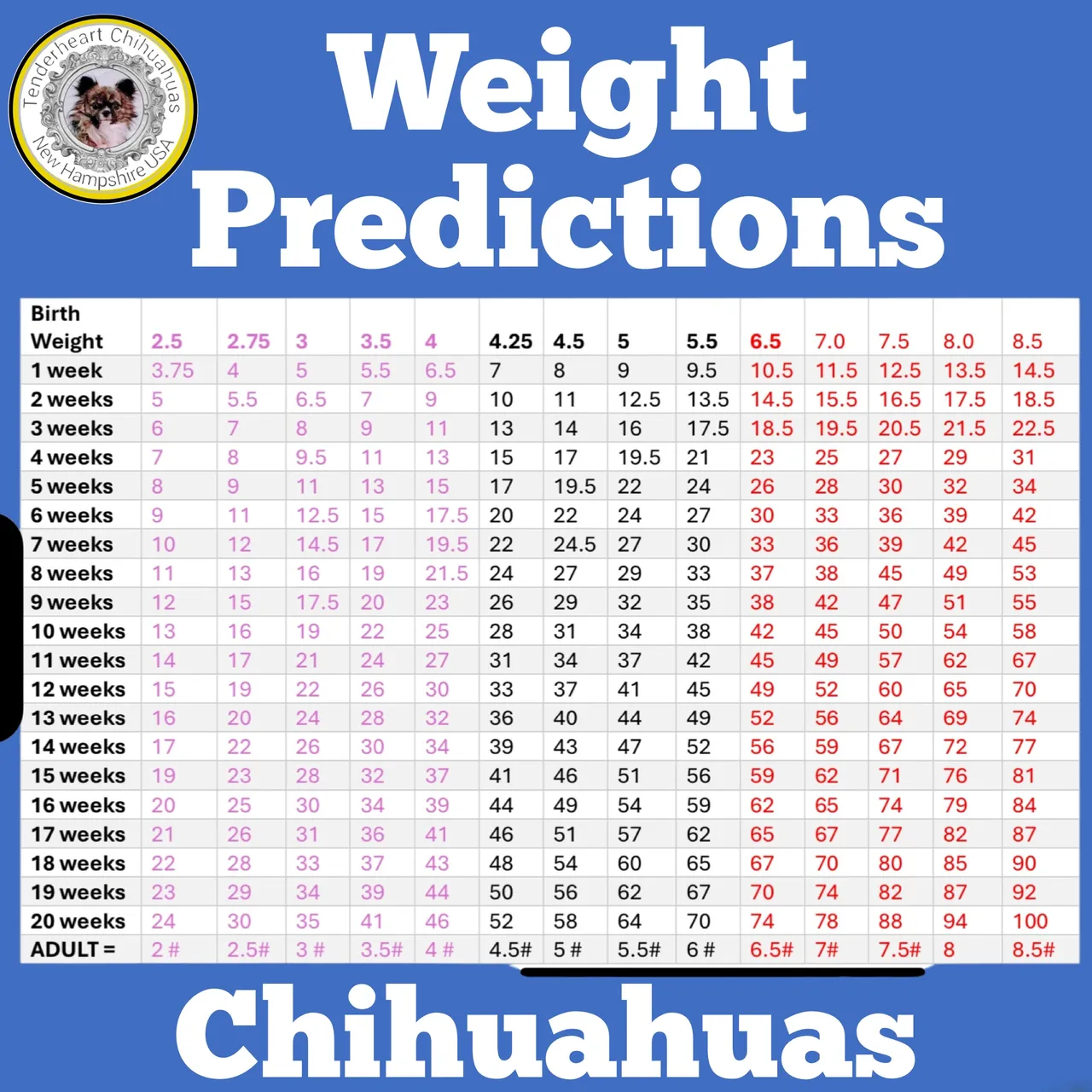
Chihuahuas that are over 6 pounds are ineligible to compete in conformation events but may still participate in agility. Many chihuahuas start showing competitively and complete their titles prior to a year old. Sometimes they may grow to exceed the 6-pound maximum weight requirement for competition in some events before finishing their titles. Larger chihuahuas greater than 6 pounds make excellent family pets, and this does not make them any less purebred. Structure and bone density, genetics, and diet all contribute to the adult size your chihuahua will become. The Chihuahua is the smallest dog breed. We can do our best to guesstimate an adult weight based on tracking and trending growth and size of the parents, but there is no possible way to guarantee adult weight. ... Read More
Links to Learn More!
standard poodle. This is not true
There is no such thing as a Teacup Chihuahua
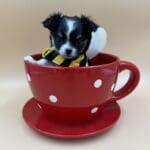 ( large soup mug pictured here)
A teacup chihuahua is not real. Chihuahuas do not come in Teacup size. Even the tiniest of 2 pounds would not fit in a Teacup. The term TEACUP is very much discouraged or considered taboo by knowledgable, reputable breeders for a few really good reasons. Chihuahuas can mature at a wide variety of adult weights ranging 2-16 pounds or maybe more. See our weight chart above to get an idea of what we mean. In some breeds, there are different sizes that are recognized such as a toy poodle vs. a standard poodle. This is not true for chihuahuas. Chihuahuas are simply a toy breed. Yes, it's true that there are some chihuahuas that stay tiny and mature at under 3 pounds, ( which in my mind is what I would consider "teacup" if that class existed... The ethical issue at hand is that using this term implies that it is a different type of chihuahua, which it is not. Deceptive tactics can mean only one thing... bad breeding practices. There are people out there in this world that do not care at all about the health or longevity of the puppies they produce and intentionally breed the tiniest runts to the tiniest runts, often to these poor dogs' demise. They perpetuate health issues that could be avoided by breeding to standard instead of breeding to create "teacup" size. What is actually being created is a puppy that will very likely live a fragile, unhealthy, shortened life at the vet. All at the expense of your heartache and pocketbook. Breeders that care about you and the puppies they produce, and their breeding dogs will be honest and open about the Teacup Myth, because we want this to stop. We want bad breeders to stop jeopardizing the health of their dogs to produce sickly micro-teacup sized chihuahuas, as it's a cruel practice aimed at nothing but profit and causes a lifetime of heartache.
IF that tiny, tiny dog is what you are after? choose one from a reputable breeder that has a few smaller puppies but breeds to standard. We occasionally have smaller puppies that will mature on the smaller end of standard? We call them Tinies. It happens time to time that we have Tinies, and for us here, that does not mean that they would be born unhealthy... as they are not from tiny unhealthy runt adults, and typically mature at 3-3.5 pounds which is the lighter end of the breed standard.

standard poodle. This is not true